 VapeWholesaleHub
Atomizers Specifications Every Buyer Should Check — Convenience Retail
Retailers rarely lose money on atomizers because of price. They lose money because the first container was bought on a photograph. This page walks through what actually matters when you source atomizers at scale, written from the buying desk rather than the marketing department.
Inspection Before Dispatch
Most defects in atomizers are not dramatic. They are loose tolerances, a slightly thin seal, a mouthpiece that clicks. Left alone they turn into leak complaints, which are the single most common reason a retailer drops a line.
- Ask how the factory measures puff count, then compare like with like.
- Write the complaint threshold into the order terms.
- Model landed cost, not ex-works price, when comparing quotes.
- Start with a mixed carton and let your own sell-through decide.
- Rotate stock by batch code rather than by delivery date.
Selling Atomizers at Store Level
Rotate atomizers facing rather than price for the first month. Visibility changes sell-through more reliably than a small discount, and it does not train customers to wait for offers.
Bundle atomizers with a complementary item rather than discounting it outright. The perceived value holds up better and the second item often becomes a repeat purchase on its own.
The Specification That Matters
When we write a atomizers specification with a distributor, we fix four things first: the resistance band, the liquid capacity tolerance, the puff count methodology and the packaging master carton. Everything else can flex without changing the customer experience.
| Product category | Disposable |
|---|---|
| Resistance band | 1.0 - 1.2 ohm |
| Capacity tolerance | +/- 5% |
| Puff count method | Machine cycle 2s on / 18s off |
| Master carton | 100 units |
| Carton weight | 5.6 kg |
| Shelf life | 12 months |
| Storage | 15-25 C, dry, away from direct light |
Freight, Customs and Timing
Ask your forwarder for the atomizers transit history on your lane, not the advertised schedule. The gap between the two is the buffer you should build into your reorder point.
Carton dimensions for atomizers are a design decision, not a packing afterthought. A few centimetres on the master carton can change how many units fit a pallet, and that repeats on every order.
Modelling a Healthy Margin
Margin on atomizers is rarely lost at the till. It is lost through dead stock, returns and emergency air freight. A slightly higher landed cost with predictable lead time usually beats the cheapest quote on the spreadsheet.
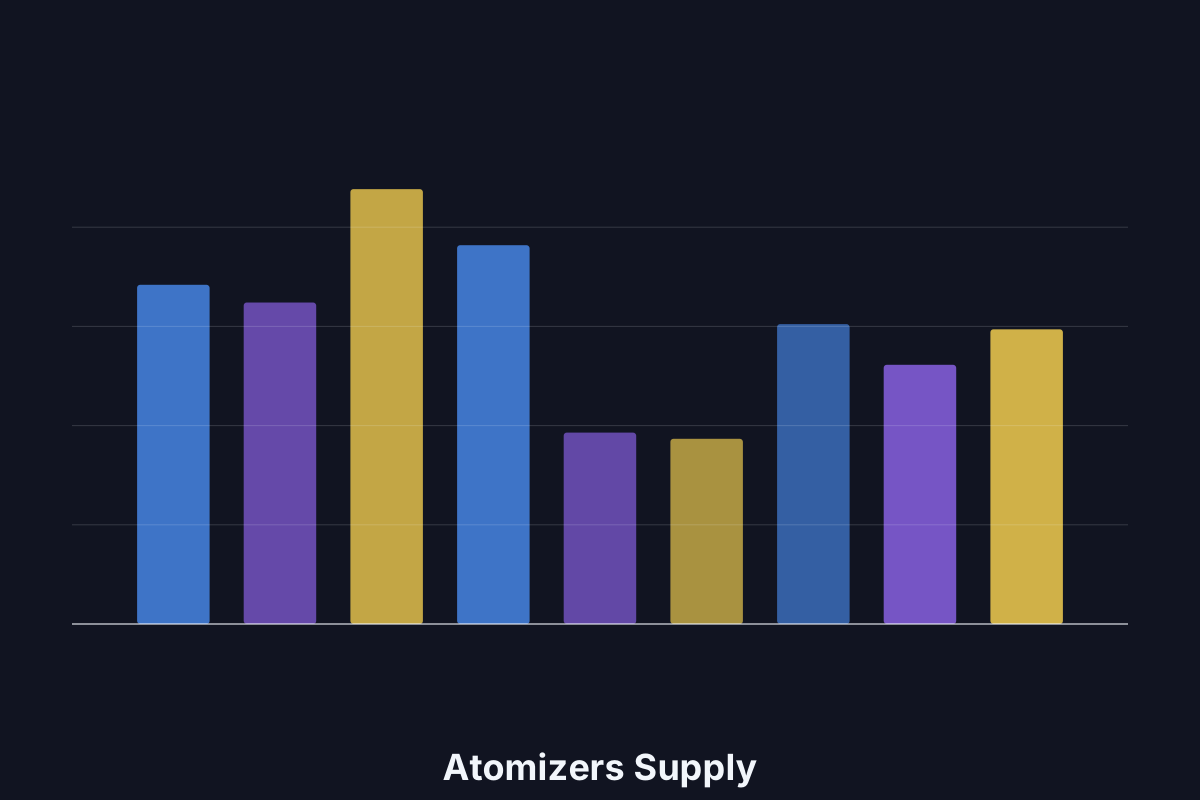
Indicative reference points for planning purposes: entry tier from USD 0.98 per unit at 2000 units, mid tier at USD 0.72, and volume tier at USD 0.96 for full container quantities. These figures move with specification, packaging and freight, so treat them as a shape rather than a quote.
Practical Checklist
- Ask how the factory measures puff count, then compare like with like.
- Rotate stock by batch code rather than by delivery date.
- Agree the tolerance band in writing before approving artwork.
- Plan the switch from air to sea freight before you need it.
- Keep sealed retained samples from every production batch.
- Start with a mixed carton and let your own sell-through decide.
Frequently Asked Questions
Do you hold stock for regular customers?
For established programmes we can reserve production slots and, in some cases, hold finished atomizers stock against a forecast. It removes most of the lead time risk from a reorder and is worth discussing once volumes are stable.
Can you match an existing product I already sell?
Often yes, provided we can measure it properly. Send a physical sample and we will report back on what can be matched, what will differ slightly, and why. An honest gap is more useful than a vague promise.
What is the usual minimum order for atomizers?
For a standard production run the minimum is normally one master carton per flavour, though mixed cartons can be arranged for a first order. If you are testing the line, ask about a sample pack first and treat the freight as part of your research budget.
How should atomizers be stored?
Cool, dry and out of direct sunlight. Heat and light are the two things that shorten shelf life fastest. Rotate stock by batch code rather than by arrival date, and keep cartons off concrete floors in humid warehouses.
What information do you need to quote?
Target specification, approximate quantity, destination and any packaging requirement. With those four we can usually come back with a costed option the same working day rather than a request for more information.
Next Step
If you are comparing options right now, send us the specification you have been quoted elsewhere. A side by side reading usually shows where the price difference actually comes from, and that is the most useful first conversation to have.
Related Reading
- Atomizers Emissions and Leak Testing Methods — Highly Regulated Markets
- Atomizers Specification Change Control — Retail Chains
- Atomizers Compliance Basics for Importers — New Distributors
- Atomizers Buyer FAQ for First Time Importers — Container-Scale Orders
- Atomizers Trade Show Buying Tactics — EU Markets
- Atomizers Tamper Evidence and Seal Integrity — Entry-Level Price Points