 VapeWholesaleHub
Atomizers Assortment Depth Versus Breadth — Convenience Retail
Treat atomizers as a repeat purchase category rather than a one off buy. That single change in framing alters almost every decision downstream, from carton size to how many strengths you list.
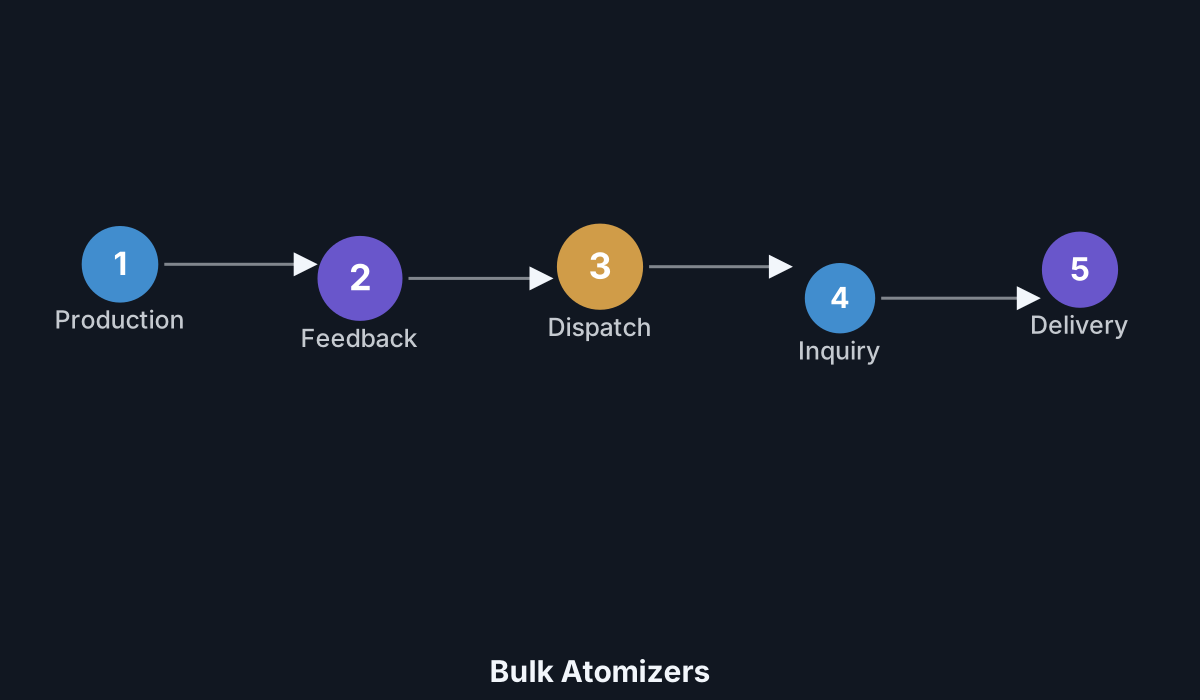
How Atomizers Fits the Assortment
Before anything else, decide which customer you are buying atomizers for. A convenience counter with limited shelf depth needs a tight range that turns quickly, while a specialist shop can carry a deeper ladder of options and educate buyers into higher ticket lines.
Think about where atomizers sits in your customer's week. If it is a weekly restock, breadth matters less than availability. If it is an occasional treat, flavour range and display story carry more weight.
How Atomizers Batches Are Checked
Random checks are fine, but weight the sample towards the start and end of a atomizers production run. Those are where a line is most likely to drift.
- Ask how the factory measures puff count, then compare like with like.
- Agree the tolerance band in writing before approving artwork.
- Write the complaint threshold into the order terms.
- Rotate stock by batch code rather than by delivery date.
- Confirm the current customs classification with your own broker.
Freight, Customs and Timing
Ask your forwarder for the atomizers transit history on your lane, not the advertised schedule. The gap between the two is the buffer you should build into your reorder point.
Air freight makes sense for a first atomizers order when you need to test demand quickly, but almost every steady programme moves to sea freight once volumes stabilise. Planning that switch early avoids a painful margin squeeze later.
The Specification That Matters
Pay attention to how a atomizers supplier responds when you ask for a tolerance they do not want to commit to. The hesitation is usually more informative than the eventual answer.
| Product category | Open system |
|---|---|
| Resistance band | 1.2 - 1.4 ohm |
| Capacity tolerance | +/- 5% |
| Puff count method | Machine cycle 3s on / 27s off |
| Master carton | 400 units |
| Carton weight | 6.0 kg |
| Shelf life | 24 months |
| Storage | 15-25 C, dry, away from direct light |
What Atomizers Really Costs Landed
Margin on atomizers is rarely lost at the till. It is lost through dead stock, returns and emergency air freight. A slightly higher landed cost with predictable lead time usually beats the cheapest quote on the spreadsheet.
Indicative reference points for planning purposes: entry tier from USD 2.27 per unit at 2000 units, mid tier at USD 1.17, and volume tier at USD 1.21 for full container quantities. These figures move with specification, packaging and freight, so treat them as a shape rather than a quote.
Practical Checklist
- Confirm the current customs classification with your own broker.
- Write the complaint threshold into the order terms.
- Agree the tolerance band in writing before approving artwork.
- Rotate stock by batch code rather than by delivery date.
- Ask how the factory measures puff count, then compare like with like.
- Keep sealed retained samples from every production batch.
Frequently Asked Questions
What if a batch does not match the sample?
Keep the retained samples from the approval stage. If a delivered batch measurably differs, we compare against the retained set and resolve it against the production record. This is why we insist on sealed retained units from every run.
What if I only need a small first order?
That is normal and sensible. A mixed carton lets you test atomizers in your own market before committing to a production run, and the specification you approve at that stage carries through to larger orders unchanged.
How long does a atomizers order take to arrive?
Production typically takes ten to eighteen working days after artwork approval, and transit depends on the method you choose. Air express is fastest, sea freight is cheapest at volume. We confirm both at quotation so there is no surprise later.
How are price changes handled on repeat orders?
{K} pricing is reviewed against input costs and volume rather than adjusted casually. Any change is confirmed in writing before the next order is scheduled, with the reason stated so you can judge it yourself.
What information do you need to quote?
Target specification, approximate quantity, destination and any packaging requirement. With those four we can usually come back with a costed option the same working day rather than a request for more information.
Next Step
Questions that are not answered here are usually the interesting ones. Reach out with the specifics of your market and we will answer with numbers rather than adjectives.
Related Reading
- Atomizers Coil Wire and Wicking Choices Compared — Warehouse Teams
- Atomizers Handling Product Recalls Professionally — Highly Regulated Markets
- Atomizers Competitor Range Teardown — Retail Chains
- Atomizers Handling Product Recalls Professionally — Warehouse Teams
- Atomizers Currency and Payment Risk Basics — Container-Scale Orders
- Atomizers Reorder Discipline for Busy Distributors — 2026 Edition